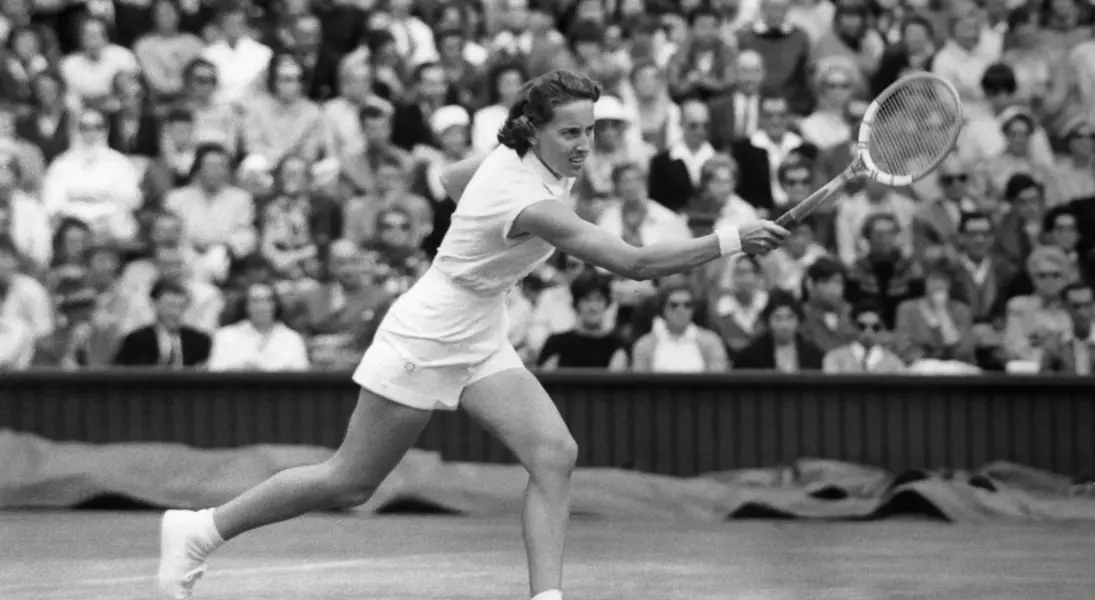
The esteemed tennis world is deeply saddened by the recent loss of Angela Mortimer Barrett, a former global number one and a revered multiple Grand Slam victor, who peacefully departed at the age of 93. Born in Plymouth, her extraordinary journey in professional tennis was marked by an array of significant triumphs, cementing her legacy as one of the sport's most formidable figures.
\nA Distinguished Career: Triumphs and Challenges on the Court
\nAngela Mortimer Barrett, a native of Plymouth, England, carved out an illustrious career in the demanding arena of professional tennis. Her pinnacle achievement arrived in 1961, when she seized the coveted Wimbledon singles title. In a gripping final, she outmaneuvered her compatriot, Christine Truman, securing victory with a resilient score of 4-6, 6-4, 7-5, a testament to her unwavering determination and skill.
\nBeyond the hallowed grass courts of Wimbledon, Barrett's formidable talent shone brightly on other Grand Slam stages. Her initial major championship triumph came at the French Open in 1955, where she meticulously defeated America's Dorothy Knode in a hard-fought encounter, finishing 2-6, 7-5, 10-8. Just three years later, she added the Australian Open singles crown to her collection, overcoming Lorraine Coghlan in straight sets with a decisive 6-3, 6-4.
\nWhile the US Open remained an elusive singles title, with her deepest run being a semifinal appearance in 1961 against Ann Haydon, Barrett did claim the Wimbledon doubles title in 1955. Partnering with Anne Shilcock, they elegantly dispatched the duo of Shirley Bloomer and Pat Ward with a score of 7-5, 6-1, showcasing her versatility.
\nThe 1958 Australian Open stands out as a remarkable chapter in her career, where she competed in three distinct categories, reaching the final in each. Although she captured the singles championship, she was runner-up in both the doubles and mixed doubles events. In the doubles final, alongside Lorraine Coghlan, she fell to Mary Bevis Hawton and Thelma Coyne Long. Similarly, in mixed doubles, she and Peter Newman were bested by Mary Bevis Hawton and Bob Howe.
\nA compelling aspect of Barrett's storied career was her profound battle with hearing impairment. She candidly spoke about this challenge in later interviews, revealing her unique experience on the court. "I could hear the applause of the crowd, but not much else. I think it helped me concentrate, shutting out distractions. When I hear players say they need to hear the ball, I smile. I couldn't," she once shared, highlighting her extraordinary ability to adapt and excel despite adversity.
\nIn recognition of her immense contributions and achievements, Angela Mortimer Barrett was deservedly inducted into the International Tennis Hall of Fame in 1993. Upon her recent passing, Debbie Jevans, the esteemed chair of the All England Club, offered heartfelt condolences and a profound tribute to Barrett's enduring impact. "An honorary member since her triumph in 1961, Angela has been a familiar face and valued member for more than six decades. Her passing leaves a hole in the fabric of the club, and she will be greatly missed," stated Jevans, extending sympathies to Angela's husband, John, their children Michael and Sarah Jane, and their grandchildren, family, and friends.
\nAngela Mortimer Barrett's journey serves as a poignant reminder that true greatness transcends physical limitations. Her unparalleled focus, honed by the unique circumstances of her hearing, allowed her to achieve remarkable feats in a sport that demands intense auditory and spatial awareness. As a sports enthusiast, her story inspires profound admiration, underscoring the power of the human spirit to overcome obstacles and achieve legendary status. Her legacy is not merely defined by her numerous titles but by the courage and grace with which she navigated her challenges, forever etching her name in the annals of tennis history as a beacon of resilience and an embodiment of competitive excellence.